
Paris-Saclay University
Junior Member
Institut Universitaire de France
Research interests
My research centers on the field of experimental solid-state physics, with a specific emphasis on quantum materials exhibiting remarkable properties due to the presence of strongly correlated electrons. I am intrigued by the simultaneous existence or competition of various orders within these systems, encompassing phenomena such as metal-insulator transitions (Mott physics), unconventional superconductivity, frustrated magnetism, and multiferroics.
I am based at the Solid State Physics Laboratory, where I have developed an X-ray diffraction setup under high pressure and low temperature conditions. This setup allows for the measurement of both powders or single crystals. Concurrently, I am an affiliated scientist at the SOLEIL synchrotron, working on the GALAXIES beamline dedicated to X-ray absorption and emission spectroscopy (XAS, XES, and RIXS). I am also affiliated with the Léon Brillouin Laboratory at CEA Saclay, focusing on themes related to neutron diffraction and inelastic neutron scattering.
Dowload full Curriculum Vitae (in french)
Experimental techniques
- X-ray Scattering (XRD, XAS, XES and RIXS)
- Neutron Scattering (Diffraction, INS)
- Infrared and Raman Spectroscopy
Sample Environment
- Low Temperature
- High Pressure
- High Magnetic Field (static and pulsed)
- Electric Field
Former and current PhDs
- 2025–2028 Ethan Saïman — Orbital imaging in correlated quantum materials
- 2025–2028 Laure Thomarat — Study of magnetism and electronic structure of Kagome materials
- 2023–2026 Yassine Oubaid — Study of the interplay of magnetism, structure, and electronic properties in the Iron-Based spin ladder BaFe2S3
- 2021–2024 Antoine Roll — Spectroscopie et dynamique de spin des systèmes frustrés : des pnictures aux pyrochlores
- 2018–2022 Antoine Vaunat — Nouvelle excitation hybride dans les matériaux fortement corrélés : l’électromagnon
- 2018–2022 Wengen Zheng — Study of the crystal and magnetic structures of the quasi-one-dimensional iron-based superconductor BaFe2Se3
- 2015–2018 Wei Peng — Influence of the Pressure on the Multiferroicity of RMn2O5
- 2014–2017 Ghassen Yahia — Étude des interactions d’échanges dans les oxydes multiferroïques RMn2O5
Former and current Post-docs
- 2025–2027 Zamzama Rahmany
- 2025–2027 Naveen Dhami
- 2013–2015 Sumanta Chattopadhyay
Former and current BSc and MSc students
- 2025 Laure Thomarat
- 2025 Ethan Saïman
- 2024 Anass Chaabi
- 2024 Roméo Morlevat-Grivot
- 2022 Timothée Vasina
- 2022 Laure Thomarat
- 2021 Khiem Tu Khiem
- 2021 Moses Alhassan
- 2021 Paul Pineau
- 2019 Pierre Vallet
- 2018 Antoine Vaunat
2026
- [66] Ground state of BaFe2S3 from lattice and spin dynamics
Y. Oubaid, S. Deng, N. S. Dhami, M. Verseils, D. Bounoua, A. Forget, D. Colson, P. Foury-Leylekian, M.B. Lepetit, and V. Balédent
Physical Review B (2026) - [65] S. Chattopadhyay, L. Thomarat, C.S. Ong, K. Kargeti, Lipika, J.-P. Rueff, L. Nataf, K. Manna, S. K. Panda, C. Shekhar, and V. Balédent
Structural and magnetic phases of topological kagome metal Fe3Sn2 under pressure
Physical Review B 114, 185118 (2026) - [64] Anomalous pressure dependence of the bulk modulus and Yb valence in cubic YbPd
B. Tegomo Chiogo, V. Balédent, J.-P. Rueff, E. Saïman, V. Porée, T. Schweitzer, D. Wong, C. Schulz, T. Mazet, A. Chainani, D. Malterre, and K. Habicht
Physical Review Research 8, 033055 (2026) - [63] Altermagnetism revealed by polarized neutrons in MnF2
Q. Faure, D. Bounoua, V. Balédent, A. Gukasov, V. O. Garlea, A. Ribeiro, J. G. Rau, S. Petit, P. McClarty
Science (2026) - [62] Structural and textural analysis of the precursor of Laponite synthesis: enhanced hydrogen adsorption in a clay material
M. AbdelSater, M. Lanson, V. Magnin, E. Paineau, C. Coelho, D. Vantelon, E. Elkaim, J.-P. Rueff, V. Balédent, M.-V. Coulet, V. Marry, L. Masci, L. Truche, S. Rols, P. Launois
Applied Clay Science, 290, 108236 (2026) - [61] BaFe2Se3 : a quasi-unidimensional non-centrosymmetric superconductor
S. Deng, A. Roll, W.G. Zheng, T. Vasina, D. Bounoua, P. Fertey, M. Verseils, C. Bellin, A. Forget, D. Colson, M.B. Lepetit, P. Foury-Leylekian, and V. Balédent
Physical Review B Letter 113, L121105 (2026) - [60] New insight on the phase diagram of the superconducting iron spin ladder BaFe2S3
Y. Oubaid, V. Balédent, O. Fabelo, C. V. Colin, S. Chattopadhyay, E. Elkaim, A. Forget, D. Colson, D. Bounoua, M. Verseils, P. Fertey, and P. Foury-Leylekian
Frontiers of Physics 21(5), 055201 (2026)
2025
- [59] Highly variable carbon environment in the \kappa -(BEDT-TTF)2Cu2(CN)3 salt probed by C K-edge x-ray absorption and resonant inelastic x-ray scattering spectroscopy
D. Bayo, V. Balédent, V. Ilakovac, S. Carniato, P. Foury-Leylekian, J.-P. Pouget, A. Nicolaou, K. Ruotsalainen, A. Bedounnan, M. Bouaziz, Y. Joly, K. Miyagawa, K. Kanoda, and S. Tomic
Physical Review B 111 , 125160 (2025) - [58] Spin state stability in Mn2O3 across the volume collapse phase transition under pressure to 41 GPa
V. Balédent, S.R. Shieh and J.-P. Rueff
Physical Review B 111, 035122 (2025)
2024
- [57] Magnetic interactions in the cooperative paramagnet Tb2Ti2O7
A. Roll, V. Balédent, J. Robert, J. Ollivier, C. Decorse, S. Guitteny, I. Mirebeau, and S. Petit
Physical Review Research 6, 043011 (2024) - [56] Elucidating Supercrystal Mechanics and Nanoparticle Size and Shape Effects Under High Pressure
C. Hotton, D. García-Lojo, E. Modin, R.Nag, S. Gómez-Graña, J. Marcone, J. Gabriel Trazo, J. Bodin, C. Goldmann, T. Bizien, I. Pastoriza-Santos, B. Pansu, J. Pérez-Juste, V. Balédent, C. Hamon
Small Structure 2400303 (2024) - [55] Synchrotron x-ray diffraction and DFT study of non-centrosymmetric EuRhGe3 under high pressure
N. S. Dhami, V. Balédent, I. Batistic, O. Bednarchuk, D. Kaczorowski, J. P. Itiée, S. R. Shieh, C. M. N. Kumar, and Y. Utsumi
High Pressure Research 44, 248 (2024) - [54] Study of the transport and magnetic properties of substituted Ba(Fe1-xNix)2(Se1-yTeY)3}
W.G. Zheng, V. Balédent, Y. Oubaid, P. Senzier, C. Colin, F. Damay, C. Pasquier, A. Forget, D. Colson, W. Xie, J.P. Xu, W. Yin, P. Miao, and P. Foury-Leylekian
Physical Review B 109, 184428 (2024) -
[53] Pressure-induced structural modifications of imogolite nanotubes and of their methylated analogues
S. Rouzière, V. Balédent, J. Bodin, E. Elkaim, Y. Pan, E. Paineau, and P. Launois
Applied Clay Science, 107372 (2024)
2023
- [52] Electronic ground-state hysteresis under magnetic field in GdMn2O5
V. Balédent, A. Vaunat, S. Petit, L. Nataf, S. Chattopadhyay, S. Raymond, and P. Foury-Leylekian
Physical Review B 108, 104419 (2023) - [51] Purely antiferromagnetic frustrated Heisenberg model in spin ladder compound BaFe2Se3
A. Roll, S. Petit, A. Forget, D. Colson, A. Banerjee, P. Foury-Leylekian, V. Balédent
Physical Review B 108, 014416 (2023) - [50] High-pressure behavior of hydrophobically coated gold nanoparticle supercrystals : role of the structure
Victor Balédent, Claire Goldmann, Helen Ibrahim and Brigitte Pansu
Soft Matter 19, 3113 (2023) - [49] Pressure evolution of electronic and crystal structure of non-centrosymmetric EuCoGe3
N. S. Dhami, V. Balédent, O. Bednarchuk, D. Kaczorowski, S. R. Shieh, J. M. Ablett, J.-P. Rueff, J. P. Itié, C. M. N. Kumar, and Y. Utsumi
Physical Review B 107, 155119 (2023) - [48] Heat conduction in herbertsmithite: Field dependence at the onset of the quantum spin liquid regime
Q. Barthélemy, É. Lefrançois, J. Baglo, P. Bourgeois-Hope, D. Chatterjee, P. Lefloïc, M. Velázquez, V. Balédent, B. Bernu, N. Doiron-Leyraud, F. Bert, P. Mendels, and L. Taillefer
Physical Review B 107, 054434 (2023) (Editor’s suggestion) - [47] Origin of the Spin-glass-like Magnetic Anomaly in the Superconducting and Multiferroic Spin-ladder BaFe2Se3
W. G. Zheng, V. Balédent, L. Bocher, A. Forget, D. Colson, and P. Foury-Leylekian
Physical Review B 107, 024423 (2023) - [46] Compressibility and Structural Transformations of Aluminogermanate Imogolite Nanotubes under Hydrostatic Pressure
S. Rouzière, V. Balédent, E. Paineau, E. Elkaim, T. Bizien, L. Nataf, Y. Pan, and P. Launois
Inorganic Chemistry 62, 957 (2023)
2022
- [45] Hidden Magnetic Texture in the Pseudogap Phase of High-Tc YBa2Cu3O6.6
D. Bounoua, Y. Sidis, T. Loew, F. Bourdarot, M. Boehm, P. Steffens, L. Mangin-Thro, V. Balédent, P. Bourges
Nature Communication Physics 5, 268 (2022)
- [44] Chiral magnetic structure of spin-ladder multiferroic BaFe2Se3
W. G. Zheng, V. Balédent, E. Ressouche, V. Petricek, A. Forget, D. Colson, and P. Foury-Leylekian
Physical Review B 106, 134429 (2022) (Editor’s suggestion) - [43] Exceptionally robust magnetism and structure of SrFeO2 above 100 GPa
V. Balédent, L. Nataf and J.‑P. Rueff
Nature Scientific Report 12, 16018 (2022) - [42] Mechanics under pressure of gold nanoparticle supracrystals: the role of the soft matrix
H. Ibrahim, V. Balédent, M. Impéror-Clerc and B. Pansu
RSC Advances 12, 23675 (2022) - [41] Universal stripe order as a precursor of the superconducting phase in pressurized BaFe2Se3 Spin Ladder
W. G. Zheng, V. Balédent, C. Colin, F. Damay, J.-P. Rueff, A. Forget, D. Colson, and P. Foury-Leylekian
Nature Communication Physics 5, 183 (2022) - [40] Space Group Symmetry of BaFe2Se3: ab initio-Experiment Phonon Study
M. J. Weseloh, V. Balédent, W. Zheng, M. Verseils, P. Roy, J. B. Brubach, P. Foury-Leylekian, and M.-B. Lepetit
Journal of Physics : Condensed Matter 34, 255402 (2022)
2021
- [39] X-ray spectroscopic and first-principles investigation of lead tungstate under pressure
J. M. Ablett, S. Shieh, V. Balédent, J.C. Woicik, E. Cockayne, and E.L. Shirley
Physical Review B 104, 054119 (2021) - [38] Pressure evolution of the electronic structure of non-centrosymmetric EuRhGe3
Y. Utsumi, I. Batistic, V. Balédent, S. R. Shieh, N. S. Dhami, O. Bednarchuk, D. Kaczorowski, J. M. Ablett, and J.-P. Rueff
Electronic Structure 3, 034002 (2021) - [37] Evidence for an electromagnon in GdMn2O5 : a multiferroic with a huge electric polarization
A. Vaunat, V. Balédent, S. Petit, P. Roy, J.B. Brubach, G. Giri, E. Rebolini, P. Steffens, S. Raymond, Q. Berrod, M.B. Lepetit, and P. Foury-Leylekian
Physical Review 103, 174434 (2021) - [36] Order-disorder type of Peierls instability in BaVS3
V. Ilakovac, A. Girard, V. Balédent, P. Foury-Leylekian, B. Winkler, I. Kupčíc H. Berger, A. Bosak, and J.-P. Pouget
Physical Review B 103, 014306 (2021)
2020
- [35] Kitaev interactions in Co honeycomb antiferromagnets Na3Co2SbO6 and Na2Co2TeO6
M. Songvilay, J. Robert, J. A. Rodriguez-Rivera, W. D. Ratcliff, F. Damay, V. Balédent, M. Jiménez-Ruiz, P. Lejay, E. Pachoud, A. Hadj-Azzem, V. Simonet, and C. Stock
Physical Review B 102, 224429(2020) - [34] Spin transition in SrFeO2 under Pressure by X-ray spectroscopy
J.-P. Rueff, V. Balédent, K. Higashi, and H. Kageyama
Physical Review B 102, 235138 (2020) - [33] 4f spin driven ferroelectric-ferromagnetic multiferroicity in PrMn2O5 under magnetic field
S. Chattopadhyay, V. Balédent, S. K. Panda, Sh. Yamamoto, F. Duc, T. Herrmannsdörfer, M. Uhlarz, T. Gottschall, O. Mathon, Z. Wang, C. Strohm, M. Greenblatt, P. Foury-Leylekian, and J. Wosnitza
Physical Review B 102, 094408 (2020) - [32] New insights about the structural properties of kappa-(BEDT-TTF)2X2(CN)3 (X=Cu and Ag) Spin Liquids
P. Foury-Leylekian, V. Ilakovac, P. Fertey, V. Balédent, O. Milat, K. Miyagawa, K. Kanoda, T. Hiramatsu, Y. Yoshida, G. Saito, P. Alemany, E. Canadell, S. Tomic and Jean-Paul Pouget
Acta Crystallographica B 76, (2020) - [31] Room temperature polar structure and multiferroicity in BaFe2Se3
W. Zheng, V. Balédent, M.B. Lepetit, P. Retailleau, E. V. Elslande, C. Pasquier, P. Senzier, A. Forget, D. Colson, and P. Foury-Leylekian
Rapid Communication Physical Review B 101, 020101(R) (2020)
2019
- [30] Pressure Dependent X-ray diffraction of Multiferroic RMn2O5
W. Peng, V. Balédent, M.-B. Lepetit, A. Vaunat, E. Rebolini, M. Greenblatt, and P. Foury-Leylekian
Acta Crystallographica B 75, 687-696 (2019) - [29] Tuning competing magnetic interactions with pressure in RMn2O5 multiferroics
W. Peng, V. Balédent, C. V. Colin, T. C. Hansen, M. Greenblatt, and P. Foury-Leylekian
Physical Review B 99, 245109 (2019) - [28] The GALAXIES Inelastic Hard X-ray Scattering End-Station at the SOLEIL Synchrotron
J.M. Ablett, D. Céolin, B. Lassalle, B. Lebert, D.Prieur, M. Sauvage, Th. Moreno, S. Bac, V. Balédent, A. Ovono, M. Morand, F. Gélebart, A. Shukla and J.-P. Rueff
Journal of Synchrotron Radiation 26, 263-271 (2019)
2018
- [27] Pressure-Induced Commensurate order in TbMn2O5 and DyMn2O5 : Influence of rare earth anisotropy and 3d-4f exchange
M. Deutsch, W. Peng, P. Foury-Leylekian, V. Balédent, S. Chattopadhyay, M. T. Fernandez-Diaz, T. C. Hansen, A. Forget, D. Colson, M. Greenblatt, M.-B. Lepetit, S. Petit, and I. Mirebeau
Physical Review B 98, 024408 (2018) - [26] Emergent high-spin state above 7 GPa in superconducting FeSe
B. W. Lebert, V. Balédent, P. Toulemonde, J. M. Ablett, S. Klotz, T. Hansen, P. Rodière, M. Raba, and J.-P. Rueff
Rapid Communication Physical Review B 97, 180503(R) (2018) - [25] (BEDT-TTF)2Cu2(CN)3 Spin Liquid: Beyond the Average Structure
P. Foury-Leylekian, V. Ilakovac-Casses, V. Balédent, P. Fertey, A. Arakcheeva, O. Milat, D. Petermann, G. Guillier, K. Miyagawa, K. Kanoda, P. Alemany, E. Canadell, S. Tomic and J.-P. Pouget
Crystals 8, 158 (2018) - [24] Experimental evidences of the microscopic mechanism for the unusual spin-induced electric polarization in GdMn2O5
G. Yahia, F. Damay, S. Chattopadhyay, V. Balédent, W. Peng, M. Whitaker, M. Greenblatt, M.-B. Lepetit, and P. Foury-Leylekian
Physical Review B 97, 085128 (2018) (Editor’s suggestion) - [23] High Pressures phases of VO2 from the combination of high-pressure Raman scattering and ab initio structural search
V. Balédent, T. T. F. Cerqueira, R. Sarmiento-Pérez, A. Shukla, Ch. Bellin, M. Marsi, J-P. Itié, M. Gatti, M. A. L. Marques, S. Botti and J.-P. Rueff
Physical Review B 97, 024107 (2018) - [22] Investigation of ion aggregation in ionic liquids and their solutions with lithium salt under high pressure
K. Pilar, V. Balédent, M. Zeghal, P. Judeinstein, S. Jeong, S. Passerini, and S. Greenbaum
Journal of Chemical Physics 148, 031102 (2018)
2017
- [21] 3d-4 f coupling and multiferroicity in frustrated Cairo Pentagonal oxide DyMn2O5
S. Chattopadhyay, S. Petit, E. Ressouche, S. Raymond, V. Balédent, G. Yahia, W. Peng, J. Robert, M-B. Lepetit, M. Greenblatt, and P. Foury-Leylekian
Nature Scientific Report 7, 14506 (2017) - [20] Toward pressure-induced multiferroicity in PrMn2O5
W. Peng, V. Balédent, S. Chattopadhyay, M.-B. Lepetit, G. Yahia, C. V. Colin, M. Greenblatt, and P. Foury-Leylekian
Physical Review B 96, 054418 (2017) - [19] Recognition of exchange striction as the origin of magnetoelectric coupling in multiferroics
G. Yahia, F. Damay, S. Chattopadhyay, V. Balédent, W. Peng, E. Elkaim, M. Whitaker, M. Greenblatt, M.-B. Lepetit, and P. Foury-leylekian
Physical Review B 95, 184112 (2017)
2016
- [18] RIXS in correlated materials under extreme conditions
V. Balédent and J.-P. Rueff
High Pressure Research 36, 371 (2016) - [17] Evidence of multiferroicity in NdMn2O5
S. Chattopadhyay, V. Balédent, F. Damay, A. Gukasov, E. Moshopoulou, P. Auban-Senzier, C. Pasquier, G. André, F. Porcher, E. Elkaim, C. Doubrovsky, M. Greenblatt, and P. Foury-Leylekian
Physical Review B 93, 104406 (2016)
2015
- [16] Electronic properties of BaFe2As2 upon doping and pressure : The prominent role of the As p orbitals
V. Balédent, F. Rullier-Albenque, D. Colson, J. Ablett, and J.-P. Rueff
Physical Review Letters 114, 177001 (2015) - [15] Evidence for room temperature electric polarization in RMn2O5 multiferroics
V. Balédent, S. Chattopadhyay, P. Fertey, M. Greenblatt, and P. Foury-Leylekian
Physical Review Letters 114, 117601 (2015) - [14] Thermodynamic and neutron diffraction studies on multiferroic NdMn2O5
S. Chattopadhyay, V. Balédent, P. Auban-Senzier, C. Pasquier, C. Doubroysky, M. Greenblatt, and P. Foury-Leylekian
Physica B 460, 214 (2015) - [13] The GALAXIES beamline at the SOLEIL synchrotron: inelastic X-ray scattering and photoelectron spectroscopy in the hard X-ray range
J.-P. Rueff, J. M. Ablett, D. Céolin, D. Prieur, T. Moreno, V. Balédent, B. Lassalle-Kaiser, J. E. Rault, M. Simon and A. Shukla
Journal of Synchrotron Radiation 22 (2015)
2013
- [12] (p,T,H) phase diagram of heavy fermion systems: some systematics and some surprises from Ytterbium
D. Braithwaite, A. Fernadez-Panella, E. Colombier, B. Salce, G. Knebel, G. Lapertot, V. Balédent, J.P. Rueff, L. Paolasini, R. Verbeni, J. Flouquet
Journal of Superconductivity and Novel Magnetism 26, 1775 (2013) - [11] Investigation of the electromagnons in multiferroic TbMn2O5
S. Petit, V. Balédent, C. Doubrovsky, M.B. Lepetit, M. Greenblatt, B. Wanklyn, and P. Foury-Leylekian
Rapid Communication Physical Review B 87, 140301 (2013)
2012
- [10] Stability of the Fe electronic structure through temperature-,doping-, and pressure-induced transitions in the BaFe2As2 superconductors
V. Balédent, F. Rullier-Albenque, D. Colson, G. Monaco, and J.-P. Rueff
Physical Review B 86, 235123 (2012) - [9] Valence instability of YbCu_2Si_2 through its magnetic quantum critical point
A. Fernandez-Panella, V. Balédent, D. Braithwaite, L. Paolasini, R. Verbeni, G. Lapertot, and J.-P. Rueff
Physical Review B 86, 125104 (2012) - [8] Evidence for intra-unit-cell magnetic order in Bi2Sr2CaCu2O8+delta
S. De Almeida-Didry, Y. Sidis, V. Balédent, F. Giovannelli, I. Monot-Laffez, and P. Bourges
Physical Review B 86, 020504 (2012) - [7] Two Ising-like collective magnetic excitations in a single-layer cuprate superconductor
Yuan Li, G. Yu, M.K. Chan, V. Balédent, Yangmu Li, N. Barisic, X. Zhao, K. Hradil, R.A. Mole, Y. Sidis, P. Steffens, P. Bourges, M. Greven
Nature Physics 8, 404 (2012)
2011
- [6] Magnetic order in the pseudogap phase of HgBa2CuO4+x studied by spin-polarized neutron diffraction
Yuan Li, V. Balédent, N. Barisic, Y.C. Cho, Y. Sidis, G. Yu, X. Zhao, P. Bourges, and M. Greven
Physical Review B 84, 224508 (2011) - [5] Evidence for competing magnetic instabilities in underdoped YBa2Cu3O6+x
V. Balédent, D. Haug, Y. Sidis, V. Hinkov, C. T. Lin, and P. Bourges
Physical Review B 83, 104504 (2011)
2010
- [4] Hidden magnetic excitation in the pseudogap phase of a model cuprate superconductor
Y. Li, V. Balédent, G. Yu, N. Barisic, K. Hradil, R. A. Mole, Y. Sidis, P. Steffens, X. Zhao, P. Bourges, M. Greven
Nature 468, 283 (2010) - [3] 2D orbital-like magnetic order in La2-xSrxCuO4
V. Balédent, B. Fauqué, Y. Sidis, N.B. Christensen, S. Pailh\`es, K. Conder, E. Pomjakushina, J. Mesot, P. Bourges
Physical Review Letters 105, 027004 (2010)
2008
- [2] Nature of the enigmatic pseudogap state: novel magnetic order in superconducting HgBa_2CuO_{4+x}
Y. Li, V. Balédent, N. Barisic, Y. Cho, B. Fauqué, Y. Sidis, G. Yu, X. Zhao, P. Bourges, M. Greven
Nature 455, 372 (2008) - [1] Observation of Magnetic Order in a superconducting YBa2Cu3O6.6 single crystal using polarized nuetron scattering
H.A. Mook, Y. Sidis, B. Fauqué, V. Balédent, P. Bourges
Rapid Communication Physical Review B 78, 020506(R) (2008)

Kagome compounds: magnetism, topology and electronic structure
(New thematic)
Kagome-lattice metals — a 2D network of corner-sharing triangles — are a condensed-matter system where lattice geometry alone imposes strong constraints on the electronic structure: tight-binding models on this lattice generically produce a flat band, Dirac crossings, and van Hove singularities sitting close to the Fermi level. This combination makes kagome metals unusually sensitive to symmetry breaking: a small perturbation — magnetic order, spin–orbit coupling, or a lattice distortion — can gap out a Dirac point, polarize a flat band, or shift a van Hove singularity through Fermi level, with electronic consequences vastly disproportionate to the size of the perturbation itself. This is precisely why kagome magnets have become a central platform for studying the interplay between geometric frustration, band topology and electronic correlations, alongside phenomena such as the giant anomalous Hall effect, charge-density-wave order and unconventional superconductivity found in the AV₃Sb₅ family.
I am interested in the Sn-based 3d-transition-metal kagome metals — FeSn, Fe₃Sn₂, CoSn — and in the more recently discovered family of distorted kagome compounds RTi₃Bi₄ (R = rare earth), because together they let one isolate a question that is hard to address in a single compound: what is the electronic consequence of putting a magnetic sublattice in structural proximity to a kagome sublattice, without the two necessarily being the same atoms? In FeSn and Fe₃Sn₂ the kagome layer itself carries the magnetic moment (Fe), and ARPES has directly resolved the massive Dirac fermions and flat bands predicted by the kagome tight-binding model, with Fe₃Sn₂ additionally hosting real-space topological spin textures (bubbles/skyrmions) tied to its strong magnetic anisotropy. CoSn is the non-magnetic isostructural reference compound, useful to isolate the purely geometric (orbital-character-driven) origin of the flat band from magnetic effects. RTi₃Bi₄, by contrast, decouples the two sublattices structurally: the kagome network is built from non-magnetic Ti, while the magnetism is carried by rare-earth ions sitting on zigzag chains in an adjacent layer — yet ARPES and XMCD studies on this family (Nd, Sm, Gd, Tb, Yb members) report clear reconstructions of the Ti-kagome band structure and sizeable anomalous Hall effects across the rare-earth magnetic ordering transition, despite Ti carrying at most a very small induced moment. That is direct evidence that the kagome bands « feel » the onset of long-range magnetic order even without hosting the moment themselves — the open question is the microscopic channel: exchange coupling to the itinerant Ti d-states, RKKY-mediated polarization, or a purely structural (distortion) response of the kagome layer that tracks the magnetic transition.
My approach combines neutron diffraction, transport, ARPES and XMCD to separate the electronic-structure response from the magnetic-moment distribution across the transition metal and rare-earth sites, using high pressure and eventually uniaxial strain as a tuning parameter.
Figure : Crystallographic structure of RTi₃Bi₄ Ti kagome structure wit titanium kagome layers in blue and Rare earth site in green.

Altermagnetism
(New thematic)
Altermagnets are a recently identified third class of collinear magnetic order, distinct from both ferromagnets and conventional antiferromagnets. Like an antiferromagnet, they have zero net magnetization and two sublattices with opposite spin; unlike an antiferromagnet, those two sublattices are related by a rotation rather than by translation or inversion. This purely symmetry-based distinction has a direct electronic consequence: it allows the electronic and magnon bands to be spin-split in momentum space even though the total moment is zero — a combination of properties (zero stray field, yet spin-polarized bands and anomalous transport) that is highly attractive for antiferromagnetic spintronics, and that neither a ferromagnet nor a standard antiferromagnet can offer.
Because the altermagnetic classification is a statement about crystal and magnetic symmetry, establishing it unambiguously requires more than observing a band or magnon splitting — a splitting can also arise from comparatively mundane effects such as long-range dipolar coupling, so a splitting alone is not sufficient proof. Our contribution has been to show that polarized inelastic neutron scattering gives a genuinely model-independent signature: by measuring the chirality of the magnon excitations rather than just their energy, one can isolate the symmetry-protected altermagnetic component from the trivial dipolar splitting. We demonstrated this on MnF₂ — a compound long regarded as the textbook archetype of a simple antiferromagnet — where a small, long-anticipated dipolar splitting of the magnon branches had already been observed, but where our polarized, domain-biased measurement revealed a chirality in the neutron cross-section that reverses sign between the two magnon modes. That sign reversal, and not the splitting itself, is the smoking gun for altermagnetism.
This result establishes a general spectroscopic protocol — rather than a one-compound result — for testing altermagnetism directly from the spin excitations, which I am now extending to other candidate rutile and transition-metal fluoride/oxide/dichalcogenures compounds.
References : [63]
Figure : Polarized inelastic neutron scattering evidence for altermagnetism in MnF₂. (a,c) Measured sum and difference of the scattering intensity for opposite incident neutron polarizations along Q = (H,H,1); the difference (c) isolates the chiral part of the cross-section, absent in a conventional antiferromagnet. (b,d) Corresponding spin-wave spectrum and magnon chirality calculated from the fitted exchange Hamiltonian. The sign reversal of the chiral signal between the two magnon branches in (c,d) is the direct spectroscopic signature of altermagnetism.
BaM2X3 : quasi 1d strongly correlated materials
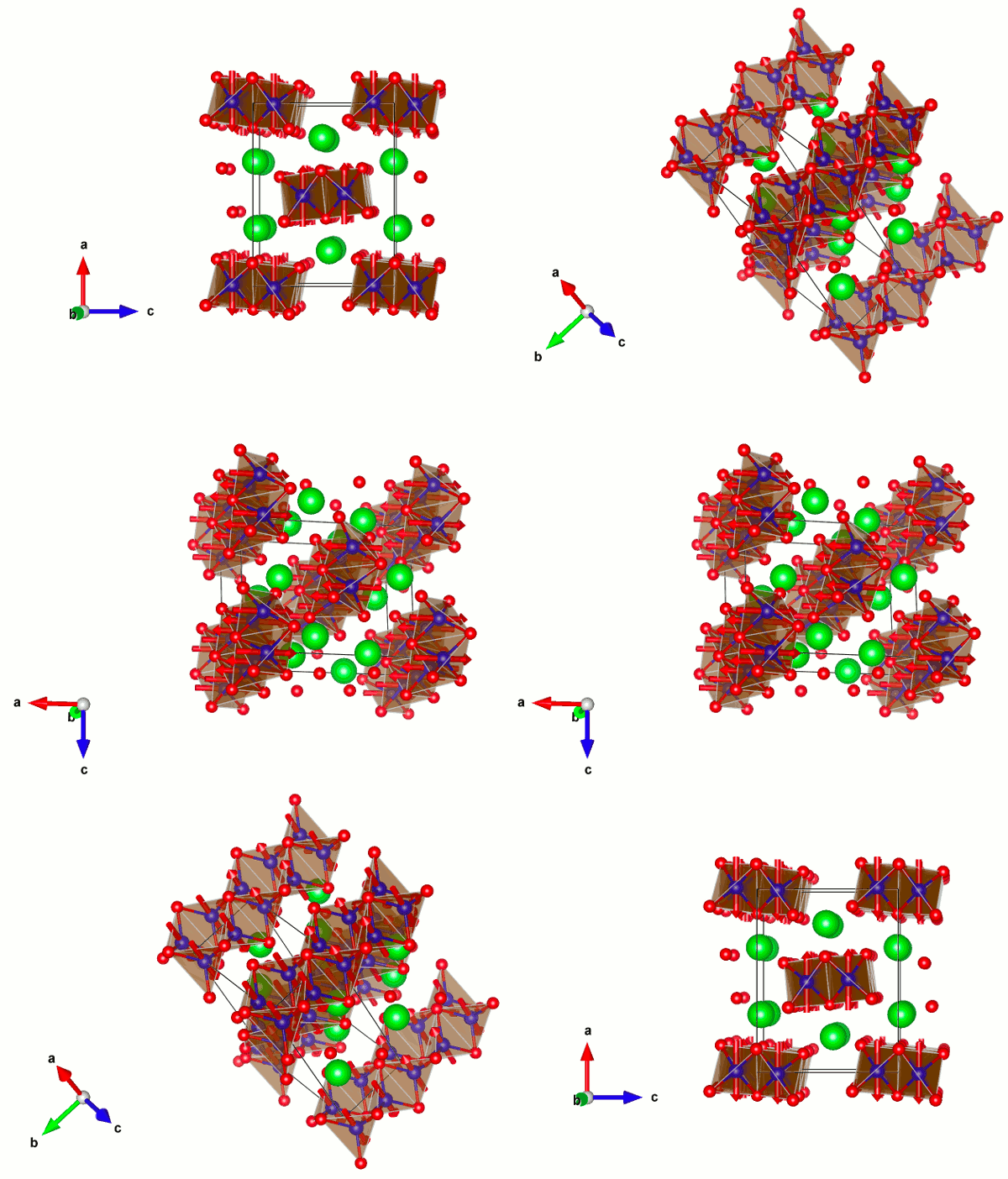
The BaM₂X₃ family (M = Fe, Co, Ni; X = S, Se, Te) — best exemplified by the iron-based two-leg spin ladder BaFe₂Se₃ — offers a rare setting in which several instabilities of strongly correlated electrons develop on the same lattice and compete for the same electrons: block-type antiferromagnetism, a Mott-like metal–insulator transition, ferroelectric polar distortions, and pressure-induced superconductivity. The reduced dimensionality (quasi-1D ladders rather than 2D planes) is not incidental: it enhances quantum and thermal fluctuations relative to the 2D cuprate case, pushes the system closer to instability, and makes the coupling between spin, charge and lattice degrees of freedom unusually strong and experimentally tractable.
My work focuses on mapping the multi-dimensional phase diagram of this family — doping (M-site and X-site substitution), hydrostatic pressure, temperature, and magnetic/electric field — using combined single-crystal and powder X-ray/neutron diffraction, resonant scattering, and transport, to identify which microscopic ingredient (superexchange topology, spin-lattice coupling, orbital selectivity) controls the transition sequence from insulating block-magnet to metal to superconductor. A central open question is whether the room-temperature polar (ferroelectric) phase we identified in BaFe₂Se₃ — overturning the previously accepted centrosymmetric structure [31] — is a prerequisite for the multiferroic coupling, or a parallel instability that happens to share the same lattice. Subsequent work traced how this block-magnetic order evolves into a stripe-type precursor state just before the pressure-induced superconducting dome opens [41], directly connecting the magnetic and electronic phase diagrams.
References : [31,40,41,44,47,51,54,60,61, 63]
Figure : Atomic and magnetic structure of BaFe2Se3, in the low temprature-ambiant pressure mutliferroic phase.
RMn2O5 multiferroics
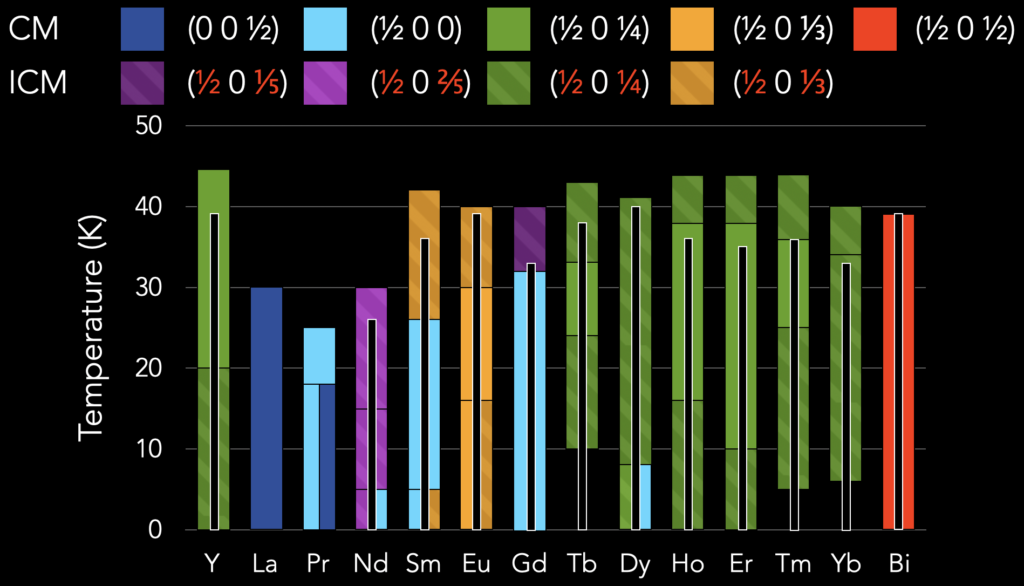
RMn₂O₅ (R = rare earth) crystals host one of the strongest known magneto-electric couplings among type-II multiferroics: the electric polarization is not an independent order parameter but is generated by the magnetic structure itself, through the inverse Dzyaloshinskii–Moriya / exchange-striction mechanism. What makes this family especially rich is the competition between several inequivalent Mn³⁺(square pyramid)–Mn⁴⁺ (octahedron) exchange paths, further complicated by the Mn–R interaction when R carries its own magnetic moment. This frustrated exchange network produces a cascade of commensurate and incommensurate magnetic propagation vectors as a function of temperature, and the polarization switches — in some cases reverses sign — precisely at the commensurate/incommensurate transitions.
My work uses this family as a controlled playground to disentangle which exchange path is responsible for which magnetic/ferroelectric instability, by systematically varying the rare-earth ion (its size and single-ion anisotropy), applying hydrostatic pressure, and using magnetic field to select between competing propagation vectors. Neutron diffraction under pressure showed that pressure can induce commensurate order in normally incommensurate members [27], demonstrating that the R-site anisotropy is not a passive spectator but actively selects the ground-state propagation vector — this was one of the threads brought together in my HDR, RMn₂O₅ Compounds: A Gateway to Multiferroic Physics (2024).
References : [11,14,15,17,19,20,21,24,27,29,30,33,37,52]
Figure : Temperature-Rare earth magnetic phase diagram of RMn2O5. Black bars represent the coexistence with electric polarization.
Evolution of the Structure of Various Clays Under Pressure
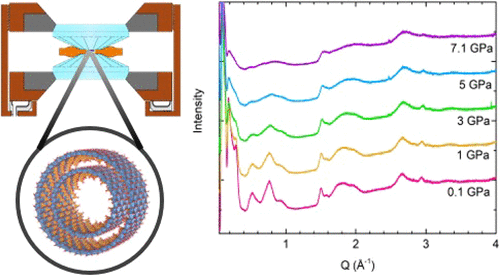
Aluminosilicate/aluminogermanate nanotubes such as imogolite and halloysite are naturally curved sheet silicates: unlike planar clays, their tubular geometry is set by a built-in lattice mismatch between the inner (Al-O) and outer (Si-O or Ge-O) surfaces, which fixes the tube diameter and wall curvature. This makes them a model system to ask how a nanotube — as opposed to a flat 2D or bulk 3D solid — accommodates hydrostatic compression: through wall bending, diameter collapse, inter-tube bundling, or a genuine curvature-dependent change of the elastic constants.
Using in situ synchrotron small- and wide-angle X-ray scattering under pressure, combined with vibrational spectroscopy and simulations, I track how tube diameter, wall thickness, and chemical substitution (single- vs. double-walled imogolite, hydrophilic vs. methyl-functionalized hydrophobic lumen, or the halloysite composition) control the pressure at which structural collapse or a bundling transition occurs, and whether that transition is reversible on decompression — which matters both for understanding clay mechanics under geological pressure and for the mechanical stability of these nanotubes as functionalized host materials.
References : [46, 53, 62]
Figure : Evolution of X-ray Scattering (SAXS) of double wall aluminogermanate Imogolite Nanotubes under pressure.
Gold Nanoparticules under High Pressure
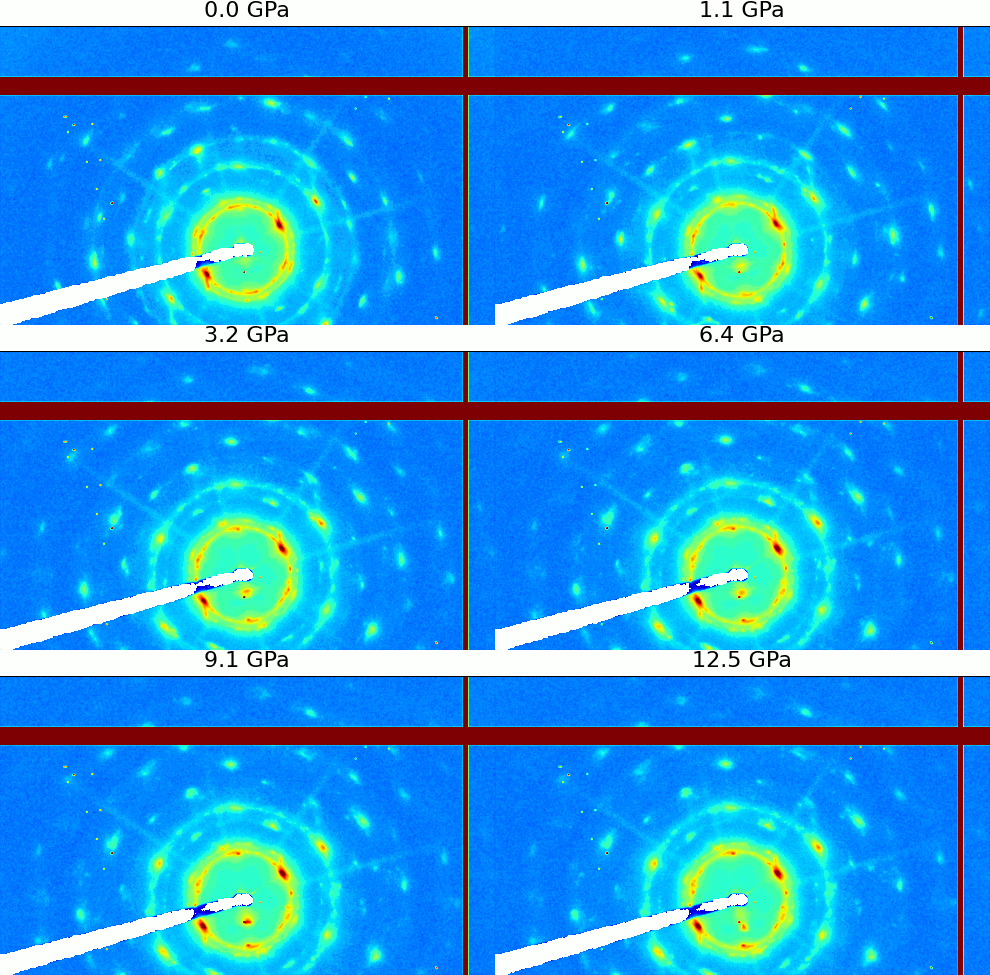
Metallic nanoparticles assembled into ordered 3D superlattices (« supracrystals ») combine two length scales that respond very differently to pressure: the crystalline gold core (a few nm) and the soft organic ligand shell that mediates inter-particle spacing and packing symmetry. This decoupling raises a genuine solid-state question: does confinement at the nanoscale change the intrinsic compressibility of gold itself (via surface stress, reduced coordination, or truncation of long-wavelength phonons), or does the apparent softening/hardening under pressure mainly reflect the mechanical response of the ligand matrix and the superlattice packing?
I address this by combining wide-angle X-ray diffraction (core lattice parameter and bulk modulus of the gold nanocrystals themselves) with small-angle X-ray scattering (superlattice symmetry, inter-particle spacing, and its evolution or collapse under load), as a function of nanoparticle diameter and ligand chemistry. The comparison between core and superlattice compressibility, and the identification of pressure-induced order–order or order–disorder transitions of the supracrystal, is what lets us separate a genuine nanoscale mechanical effect from an assembly effect.
References : [42,50,56]
Figure : Evolution of Small Angle X-ray Scattering (SAXS) of Gold NP supracrystal under pressure.
Current and Past Teaching at University Paris-Saclay
Master 2 ICFP (International Center of Fundamental Physics Concept) : Condensed Matter Physics
Lectures on Structural and Electronic properties of Solids (STM, Quantum oscillations, Cristalography, Tight bindind model…)
Practicals : RIXS, ARPES, THz spectroscopy at Synchrotron SOLEIL and STM, Quantum oscillations, diffraction, Raman and IR spectroscopy in laboratory
Master LASCALA
The slides for the lecture
Presentation
Timeline
Chapter 1 : Antiquity
Chapter 2 : Middle Ages
Chapter 3 : Paradigm Shift
Chapter 4 : Scientific journals
Chapter 5 : European Science
Chapter 6 : Diversity in Science
Chapter 7 : Ecosystem of Science
Chapter 8 : How it works
Chapter 9 : Research article
Lectures Notes
Chapter 1 : Antiquity
Chapter 2 : Middle Ages
Chapter 3 : Paradigm shift
Chapter 4 : Scientific journals
Chapter 5 : European Science
Chapter 6 : Diversity in Science
Chapter 7 : Ecosystem of Science
Chapter 8 : How it works
Chapter 9 : Research article
Master Fundamental Physics and General Physics
Quantum Solid State Physics Tutorials : from free electrons model to electrons in a periodic potential
Tutorials_1.pdf
Tutorials_2.pdf
Tutorials_3.pdf
Tutorials_solutions.pdf
Bachelor in Fundamental Physics
Practicals for quantum mechanics : Light-Matter Interaction (X-ray generation, X-Ray absorption and emission, Thomson and Compton scattering).
Ingeneer School cursus Materials (Polytech Paris-Saclay)
Lectures and tutorials on symetries, cristalography and diffraction of solids.
Download lecture (french)
TD Symétries d’orientation + Correction
TD Symétries d’orientation (supplement)
TD Réseau et Motifs + Correction
TD Réseau Direct et Réciproque + Correction
TD Facteur de structure + Correction
TD Diffraction + Correction
Partiel_2025 Partiel_2025_corrige
Partiel_2023 Partiel_2023_corrige Partiel_2022 Partiel_2022_corrige
Examen_2022 Examen_2022_corrige Examen_2023 Examen_2023_corrige
Bachelor Maths-Physics and Physics-Chemistry
Group project (4-6 students) on a physics/chemistry/maths notion or question. The objective is to present in a pedagogical manner a problematic on a given thematic, and tutored by researchers. The result is rendered in a short video of 4 minutes. Here are examples on the thematic ‘Physics of the 19th century’ :
https://www.youtube.com/embed/lFsqQ0AKUzM
https://www.youtube.com/embed/-Q02KiYOJgw
Other teaching
Neutron and Photon Spectroscopy (English)
Lecture given at GDR Meeticc school in february 2018, divided in two parts. The first part deals with generalities about inelastic physics and gives an introduction to several inelastic techniques (Raman, Infrared, Neutron and X-Ray scattering) with an overview of the physical processes involved. The second part is dedicated to magnetism, with a presentation of different kind of magnetic excitations and how to measure them with the different techniques described in the first part.
Résumé / Guide de Lecture
Part I : Introduction to Inelastic Techniques
Part II : Application to Magnetism
Introduction to Inelastic Scattering (English)
Lecture given to Hercules European School in 2019 on basic concepts of inelastic scattering and application to X-rays and Neutrons.
Slides
Contact
- victor.baledent@universite-paris-saclay.fr
- +33 (0) 1 69 15 60 46
- Laboratoire de Physique des Solides
Bat 510, Université Paris-Saclay
91405, Orsay, FRANCE
Current Teaching
Master 2 Condensed Matter Physics – International Center of Fundamental Physics Concept (ICFP)
Lectures and practicals : Structural and Electronic properties of Solids (Symmetry, Cristallography, X-ray and Neutron Diffraction…).
Tutorial 1 + Solution
Tutorial 2 + Solution
Tutorial 3 + Solution
Tutorial 4 + Solution
Master 1 Fundamental Physics
Tutorials on Basic Condensed Matter Physics
Tutorials Part 1 (french) and
Part 2 (french)
Practicals on Light Polarization and Fabry-Perot interferometer.
Licence 3 Fundamental Physics
Practicals for quantum mechanics : Light-Matter Interaction (X-ray generation, X-Ray absorption and emission, Thomson and Compton scattering).
Licence 3 Ingeneer School cursus Materials (Polytech Paris-Sud)
Lectures on structure of matter.
Licence 1 Maths-Physics and Physics-Chemistry
Group project (4-6 students) on a physics/chemistry/maths notion or question. The objective is to present in a pedagogical manner a problematic on a given thematic, and tutored by researchers. The result is rendered in a short video of 3/4 minutes. Here is an example on the thematic ‘physics of the 19th century’ :
Lecture Notes
Neutron and Photon Spectroscopy (English)
Lecture given at GDR Meeticc school in february 2018, divided in two parts. The first part deals with generalities about inelastic physics and gives an introduction to several inelastic techniques (Raman, Infrared, Neutron and X-Ray scattering) with an overview of the physical processes involved. The second part is dedicated to magnetism, with a presentation of different kind of magnetic excitations and how to measure them with the different techniques described in the first part.
Résumé / Guide de Lecture
Part I : Introduction to Inelastic Techniques
Part II : Application to Magnetism
Introduction to Inelastic Scattering (English)
Lecture given to Hercules European School in 2019 on basic concepts of inelastic scattering and application to X-rays and Neutrons.
Slides
Current Teaching
Master 2 Condensed Matter Physics – International Center of Fundamental Physics Concept (ICFP)
Lectures and practicals : Structural and Electronic properties of Solids (Symmetry, Cristallography, X-ray and Neutron Diffraction…).
Tutorial 1 + Solution
Tutorial 2 + Solution
Tutorial 3 + Solution
Tutorial 4 + Solution
Master 1 Fundamental Physics
Tutorials on Basic Condensed Matter Physics
Tutorials Part 1 (french) and
Part 2 (french)
Practicals on Light Polarization and Fabry-Perot interferometer.
Licence 3 Fundamental Physics
Practicals for quantum mechanics : Light-Matter Interaction (X-ray generation, X-Ray absorption and emission, Thomson and Compton scattering).
Licence 3 Ingeneer School cursus Materials (Polytech Paris-Sud)
Lectures on structure of matter.
Licence 1 Maths-Physics and Physics-Chemistry
Group project (4-6 students) on a physics/chemistry/maths notion or question. The objective is to present in a pedagogical manner a problematic on a given thematic, and tutored by researchers. The result is rendered in a short video of 3/4 minutes. Here is an example on the thematic ‘physics of the 19th century’ :
<!–
–>
Lecture Notes
Neutron and Photon Spectroscopy (English)
Lecture given at GDR Meeticc school in february 2018, divided in two parts. The first part deals with generalities about inelastic physics and gives an introduction to several inelastic techniques (Raman, Infrared, Neutron and X-Ray scattering) with an overview of the physical processes involved. The second part is dedicated to magnetism, with a presentation of different kind of magnetic excitations and how to measure them with the different techniques described in the first part.
Résumé / Guide de Lecture
Part I : Introduction to Inelastic Techniques
Part II : Application to Magnetism
Introduction to Inelastic Scattering (English)
Lecture given to Hercules European School in 2019 on basic concepts of inelastic scattering and application to X-rays and Neutrons.
Slides