
Aller au contenu
STEM@LPS
Menu
  • Research highlights
  • News
  • Equipment
  • People
  • Publications
  • Projects
  • Jobs
  • Login

Research highlights

News / Research highlights

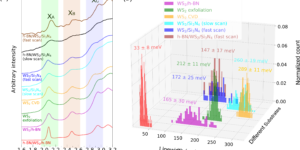
Excitonic absorption signatures of twisted bilayer WSe2 by electron energy-loss spectroscopy

Moiré twist angle underpins the interlayer interaction of excitons in twisted van der Waals hetero- and homostructures. The influence of twist angle on the excitonic absorption of twisted bilayer tungsten …
Research highlights

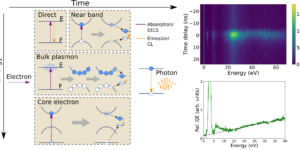
Cathodoluminescence excitation spectroscopy: Nanoscale imaging of excitation pathways

Following optical excitations’ life span from creation to decay into photons is crucial in understanding materials photophysics. Macroscopically, this is studied using optical techniques, such as photoluminescence excitation spectroscopy. However, …

Research highlights

Substrate influence on transition metal dichalcogenide monolayer exciton absorption linewidth broadening

The excitonic states of transition metal dichalcogenide (TMD) monolayers are heavily influenced by their external dielectric environment and depend on the substrate used. In this work, various wide band gap …

Research highlights

The abalone reveals its secrets about the origin of its shell

Many multicellular animals secrete a mineralized skeleton, a composite material in which the mineral phase, carbonated, phosphated or siliceous, is predominant. It is generally accepted that carbonates, which are abundant …

Research highlights

Liquid-phase sintering of lead halide perovskites and metal-organic framework glasses

Lead halide perovskite (LHP) semiconductors show exceptional optoelectronic properties. Barriers for their applications, however, lie in their polymorphism, instability to polar solvents, phase segregation, and susceptibility to the leaching of …

Research highlights

Nanoscale Modification of WS2 Trion Emission by Its Local Electromagnetic Environment

Structural, electronic, and chemical nanoscale modifications of transition metal dichalcogenide monolayers alter their optical properties. A key missing element for complete control is a direct spatial correlation of optical response …

Research highlights

Unveiling the Coupling of Single Metallic Nanoparticles to Whispering-Gallery Microcavities

Whispering-gallery mode resonators host multiple trapped narrow-band circulating optical resonances that find applications in quantum electrodynamics, optomechanics, and sensing. However, the spherical symmetry and low field leakage of dielectric microspheres …

Research highlights

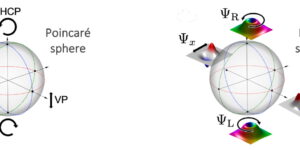
Optical polarization analogue in free electron beams

Spectromicroscopy techniques with fast electrons can quantitatively measure the optical response of excitations with unrivalled spatial resolution. However, owing to their inherently scalar nature, electron waves cannot access the polarization-related …

Research highlights

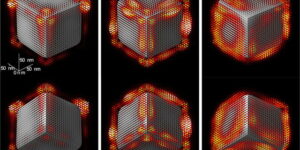
Three-dimensional vectorial imaging of surface phonon polaritons

Surface phonon polaritons (SPhPs) are coupled photon-phonon excitations that emerge at the surfaces of nanostructured materials. Although they strongly influence the optical and thermal behavior of nanomaterials, no technique has …

Research highlights

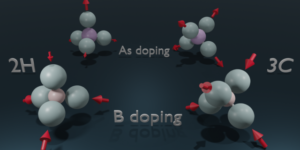
Extrinsic doping in group IV hexagonal-diamond-type crystals

Over the past few years, group IV hexagonal-diamond-type crystals have acquired a lot of attention in semiconductor physics thanks to the appearance of novel and very effective growth methods. However, …

Navigation des articles

Articles plus anciens
Articles plus récents

LABORATOIRE DE PHYSIQUE DES SOLIDES

Microscopie électronique STEM
1 rue Nicolas Appert
Bât 510 91405 Orsay Cedex

contact-equipe@universite-paris-saclay.fr

Copyright © 2021 Laboratoire de Physique des Solides