Flexible proteins for assembling viruses: from disorder to symmetry

Researchers have explained the mechanism by which identical proteins manage to organise themselves and form the perfectly symmetrical capsids of most viruses
Single-stranded RNA (ssRNA) viruses represent the largest and most diverse family of viruses known, affecting humans, animals and plants. Their formation is based on a fascinating phenomenon: hundreds of identical proteins spontaneously self-assemble to form the protective shell of the virus, called the capsid, often adopting an icosahedral symmetry of remarkable precision. However, despite decades of research, the physical and molecular mechanisms governing this self-assembly remained poorly understood.
To elucidate this process, researchers from a Franco-American collaboration involving the LPS developed an innovative molecular dynamics model combining essential elements of physics and biology, namely protein diffusion, viral genome flexibility, and a conformational switching mechanism mimicking allostery, the ability of certain proteins to change shape when binding to the site of an effector molecule (which may belong to the same protein). In this model, each protein subunit is capable of changing shape when it interacts with another, activating elastic properties that facilitate the construction of a regular shell. This flexible behaviour – absent from previous rigid models – makes it possible, for the first time, to digitally reproduce the spontaneous formation of complete icosahedral capsids corresponding to the and structures most commonly found in nature.
Simulations show that assembly does not follow a single path but occurs via several parallel pathways: shell fragments appear simultaneously at several points in the genome, then fuse and reorganise until they achieve a perfectly symmetrical structure. This dynamics ‘from disorder to symmetry’ reveals the key role of protein flexibility in overcoming the energy barriers that separate unstable states from ordered viral architectures. These results have been validated experimentally using small-angle X-ray scattering (SAXS) and cryo-electron microscopy (cryo-TEM) measurements on the plant virus CCMV (Cowpea Chlorotic Mottle Virus). The researchers showed that the secondary structure of RNA strongly influences the success of assembly: more branched, and therefore more compact, RNAs promote the formation of complete shells, while more linear RNAs lead to incomplete or irregular structures.
By demonstrating that viral symmetry emerges from universal physical principles —a subtle balance between elastic properties, electrostatic forces and genome architecture— this work represents a substantial advance in our understanding of the fundamental mechanisms of virology. This approach provides a general explanatory framework for understanding capsid formation and stability, opening up new perspectives for the design of artificial nanocapsids for encapsulating therapeutic molecules or for the design of antiviral agents targeting the early stages of viral assembly. These results are published in the journal Science Advances.
Visualizing the growth of a virus at the single-molecule level
A team of physicists from the SOBIO team and the Laboratoire Lumière, Matière et Interface (Université Paris-Saclay/ENS Paris-Saclay/CNRS/CentraleSupélec) has developed an experimental method to visualize in real time the growth of individual spherical viruses using total internal reflection fluorescence microscopy.

All viruses on Earth exploit their host’s cellular machinery to replicate. One of the crucial steps in a virus life cycle involves a complex self-assembly process, which takes place despite the macromolecular crowding and intense enzymatic activity that prevail in the cytoplasm. The simplest spherical viruses co-assemble their capsid—namely, their shell made of multiple copies of the same protein chain—with their genome, which consists of one or several single-stranded RNA segments. In the present study, we implemented an experimental method to probe virus growth dynamics at the level of individual proteins. To do this, we used total internal reflection fluorescence (TIRF) microscopy and monitored the evolution of the light intensity of hundreds of assembly sites simultaneously as fluorescent proteins attach to or detach from them. Using a step-detection algorithm combined with statistical analysis, we estimated microscopic quantities such as the binding rate and the mean residence time, which are inaccessible to traditional ensemble-averaging techniques.
How icosahedral viruses package their RNA genome
The survival of viruses partly relies on their ability to self-assemble inside host cells. Although coarse-grained simulations have identified some assembly pathways, few experimental measurements are available to date due to the difficulty of detecting biological molecules in water over a wide range of timescales.
Cowpea chlorotic mottle virus (CCMV) is an icosahedral RNA virus infecting plants. The virus was spontaneously reconstituted from purified proteins and genomic RNA, and its assembly was probed by using time-resolved small-angle X-ray scattering with a synchrotron source. Measurements revealed that the adsorption of proteins on RNA occurs in a few tens of milliseconds, while the structural reorganization of the formed species can take several hours. Before the completion of virus, the proteins are loosely bound on the RNA, which may ensure a good selectivity for the viral genome during assembly in host cell. The structural reorganization is limited by an energy barrier, thus minimizing the misassembly of the protein shell. Quite unexpectedly, viruses packaging synthetic polyelectrolytes are reconstituted more easily than viruses packaging genomic RNA, which should promote further studies on the role of genome in the self-assembly dynamics.
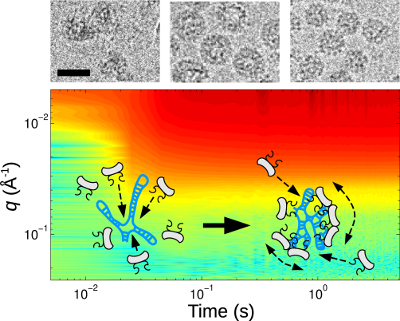
(Top, from left to right) Cryo-electron microscopy images of partially reconstituted viruses, completely reconstituted viruses and reconstitued viruses packaging polyelectrolytes. Scale bar is 30 nm. (Bottom) Schematical representation of a self-assembling virus superimposed on experimental X-ray scattering intensities. [Nat. Commun. 9 (2018) 3071]
A viral nanocage assembled within an X-ray beam
We have investigated the self-assembly of capsid proteins derived from a norovirus by time-resolved small-angle X-ray scattering (TR-SAXS) with a synchrotron source. The three-dimensional structure, at nanometre resolution, of an intermediate species that plays a pivotal role in the self-assembly was extracted through an original global fitting algorithm applied to the time-resolved data. We found that in the first step, some ten dimers combine to form this stave-shaped intermediate possibly made of two pentamers of dimers connected by an interstitial dimer. In the subsequent, slower step, which takes hours, these intermediates interlock into a capsid. In contrast, capsids form by sequential addition of dimers in many other viruses such as the hepatitis B virus.
By clarifying the kinetics involved in norovirus assembly, this study provides a better understanding of the physical processes at work in the self-assembly of a viral capsid. It could also advance efforts to treat or prevent these infections, and it could be applied to engineer viral nanocages to make diagnostic agents and tailored therapeutics.
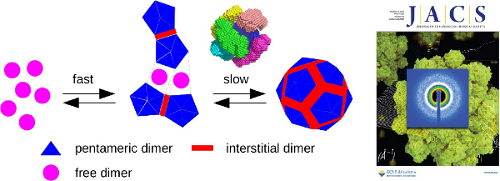
Kinetic scheme of norovirus capsid assembly. Free dimers are represented in magenta, dimers related by five-fold symmetry in the final capsid in blue, and interstitial dimers in red. Above the last assembly step, a representation of interlocking intermediates is given as a possible mechanism. Six intermediates, each in a different color, have been positioned above the six contiguous fragments made of two pentamers of dimers connected by an interstitial dimer. [J. Am. Chem. Soc. 135 (2013) 15373]
Related publications
- Siyu Li, Guillaume Tresset, Roya Zandi. From Disorder to Icosahedral Symmetry: How Conformation-Switching Subunits Enable RNA Virus Assembly, Sci. Adv. 11, 2025, ealy7241. hal-05285694. DOI: 10.1126/sciadv.ady7241.
- T. BUGEA, R. SUSS, L. GARGOWITSCH, C. TRUONG, K. PERRONET, G. TRESSET (2024) Probing Single-Molecule Dynamics in Self-assembling Viral Nucleocapsids. Nano Lett. 24 14821-14828. hal-04771478. DOI: 10.1021/acs.nanolett.4c04458
- M. CHEVREUIL, D. LAW-HINE, J. CHEN, S. BRESSANELLI, S. COMBET, D. CONSTANTIN, J. DEGROUARD, J. MÖLLER, M. ZEGHAL, G. TRESSET (2018) Nonequilibrium self-assembly dynamics of icosahedral viral capsids packaging genome or polyelectrolyte. Nat. Commun. 9 3071.
- G. TRESSET, M. CASTELNOVO, A. LEFORESTIER (2017) Assemblage et désassemblage des virus : Mode d’emploi. Reflets de la Physique 52 22-26.
- D. LAW-HINE, M. ZEGHAL, S. BRESSANELLI, D. CONSTANTIN, G. TRESSET (2016) Identification of a major intermediate along the self-assembly pathway of an icosahedral viral capsid by using an analytical model of a spherical patch. Soft Matter 12 6728-6736.
- D. LAW-HINE, A. K. SAHOO, V. BAILLEUX, M. ZEGHAL, S. PREVOST, P. K. MAITI, S. BRESSANELLI, D. CONSTANTIN, G. TRESSET (2015) Reconstruction of the disassembly pathway of an icosahedral viral capsid and shape determination of two successive intermediates. J. Phys. Chem. Lett. 6 3471-3476.
- G. TRESSET, C. LE COEUR, J.-F. BRYCHE, M. TATOU, M. ZEGHAL, A. CHARPILIENNE, D. PONCET, D. CONSTANTIN, S. BRESSANELLI (2013) Norovirus capsid proteins self-assemble through biphasic kinetics via long-lived stave-like intermediates. J. Am. Chem. Soc. 135 15373-15381.