
We demonstrate a single-photon detector operating in the microwave domain, based on photoassisted quasiparticle tunneling events that poison a superconducting island. The detection relies on continuously monitoring the island’s charge parity using microwave reflectometry. This scheme achieves 10% detection efficiency with sub 50 ns time resolution and short dead time (∼1 μs), for microwave photons at 10 GHz. The detector features three junctions connected to a superconducting island, which together carry out photoelectric conversion and charge readout. The enhanced light-matter coupling, crucial to photon-to-quasiparticle conversion, is provided by a granular aluminum-based high-impedance microwave resonator. The time-resolved detection of itinerant microwave photon opens up new perspectives in quantum sensing, microwave quantum optics, and mesoscopic physics.
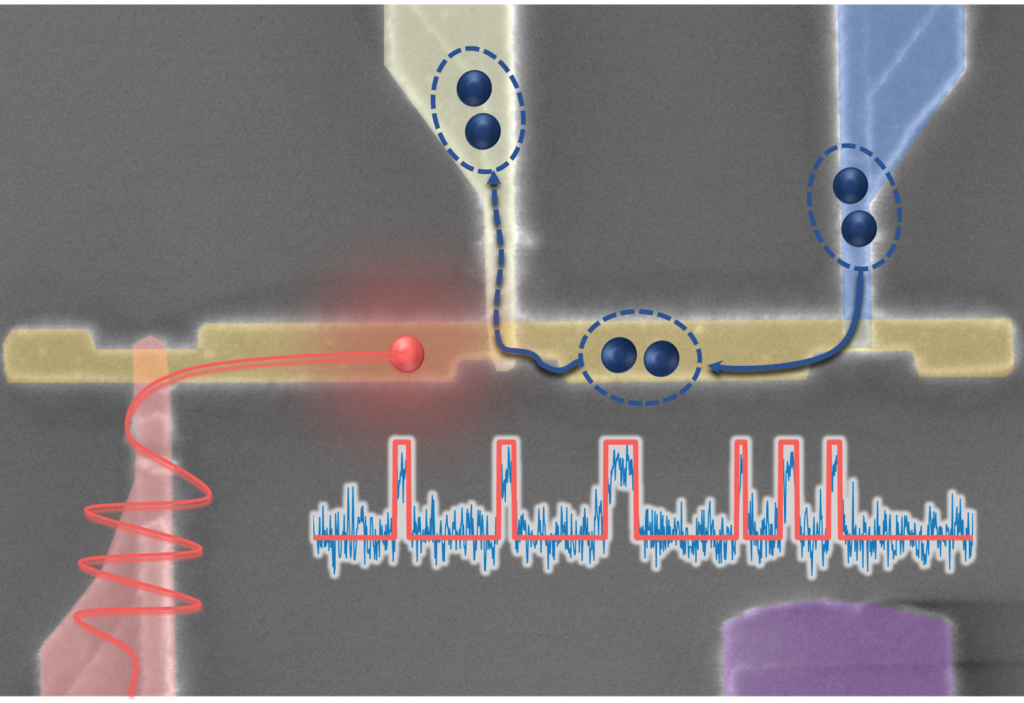
Electron microscope image of the device featuring a superconducting island connected to 3 tunnel junctions for photo-electric conversion (orange wiggle turning into a quasiparticle) and time-resolved readout (telegraph signal in inset).
Reference
Fast and Continuous Detection of Single Microwave Photons via Photoassisted Quasiparticle Tunneling to a Superconducting Island
J. Basset, O. Stanisavljević, J. Gabelli, M. Aprili, and J. Estève
Phys. Rev. Lett. 136, 237001 (2026) Editor’s suggestion
doi: https://doi.org/10.1103/PhysRevLett.133.076302
Contact
Julien Basset, Jérôme Estève