
The discovery of new cost-effective and noble metal-free materials without sacrificing catalytic performance is of high interest for electrochemical water splitting. A consortium led by researchers from Laboratoire de Physique des Solides and Institut de Chimie Physique (CNRS/UPSaclay) have demonstrated how geo-inspired clay nanotubes may represent a sustainable and credible electrocatalyst for efficient oxygen evolution reaction in electrochemical processes.
The oxygen evolution reaction (OER) is a known process, requiring four-electron transfer while facing competitive side peroxide formation. In recent years, major advances have been achieved with Ir- and Ru-based catalysts, which are considered as benchmark materials for OER. However, despite their high activity and stability, the scarcity of these elements and their high cost pose significant challenges for large-scale application compared to earth-abundant elements. Geo-inspired nanotubes, such as germanium-based imogolite (GeAl2O3(OH)4, Ge-INT), are unique objects, whose tubular structure and composition make them promising materials for catalytic reactions. In addition, the different elements of their structure can undergo selective isomorphic substitution, offering a simple way to modulate their conductivity and catalytic properties, with the major challenge of preserving the original tubular structure.
This is the strategy followed by a national consortium involving researchers from the Universities of Paris-Saclay, Cergy and Poitiers in collaboration with beamline scientists of Synchrotron SOLEIL. Through a one-step hydrothermal synthesis, iron was successfully incorporated into the Ge-imogolite framework with a general structural formula Ge(Al2-2xFe2x)O3(OH)4. For substitution ratio x = [Fe]/([Al]+[Fe]) lower than 0.1, the nanotubes’ original properties are maintained such as their monodisperse diameters, colloidal stability and unique self-organization properties (Figure 1).
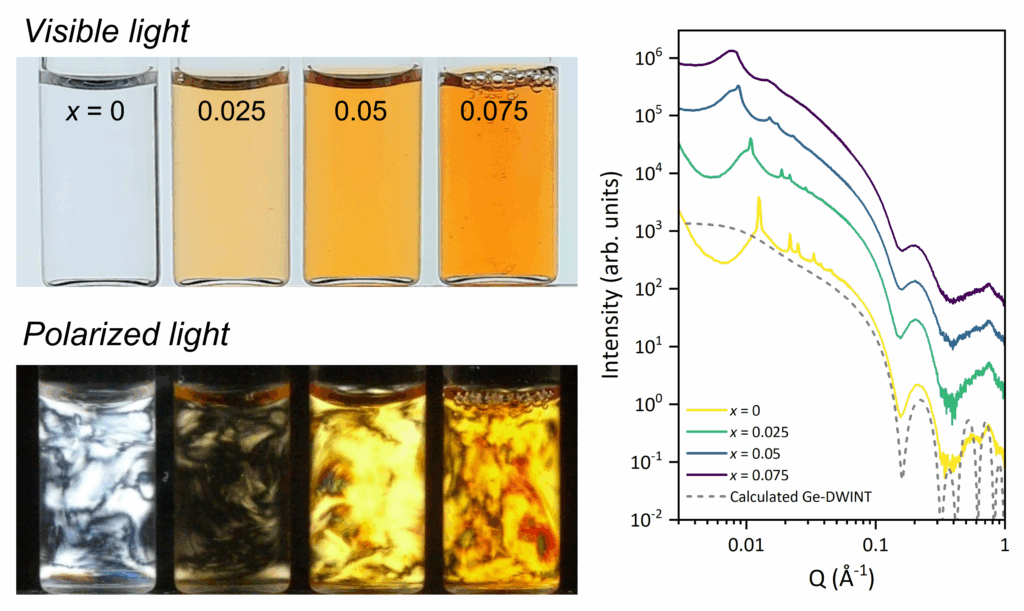
Figure 1. Characterization of Fe-doped Ge-INTs synthesized at different substitution ratios. (left) Optical observation under visible light and between crossed-polarizers. (right) Corresponding small-angle X-ray scattering diagrams compared to a calculated diagram of Ge-INT.
X-ray absorption near edge structure (XANES) spectroscopy confirmed the incorporation of Fe atoms into octahedral sites in Fe-doped Ge-INTs. To get a deep insight of the crystal-chemistry of the synthetic samples, the team quantified at the submicrometer scale the ferric/ferrous iron ratio at the L3 edge using scanning transmission X-ray microscopy (STXM-XANES). Chemical mapping at the nanometer scale reveals a homogenous distribution of Fe sites along the nanotubes with a Fe3+/SFe value always greater than 70%, regardless of the substitution ratio (Figure 2).
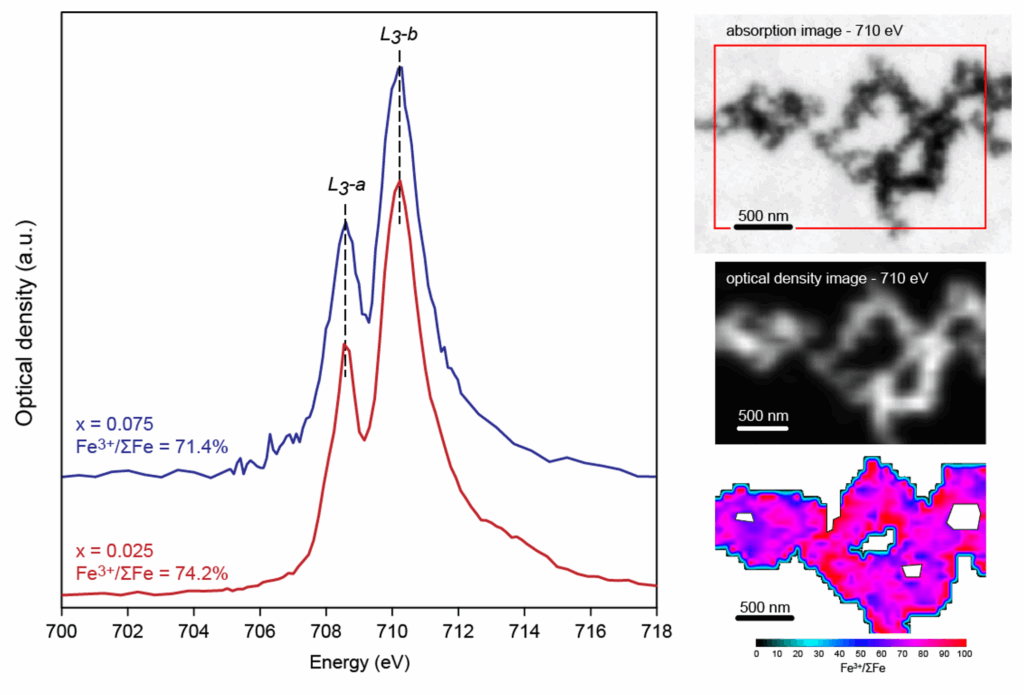
Figure 2. (left) STXM-XANES spectra at the Fe L3-edge for x = 0.025 and 0.075. Redox results are noted on the color scales and beside spectra. (right) X-ray absorption and optical images extracted at the Fe L3-edge maximum intensity (710 eV) and the corresponding redox map for Fe (Fe3+/ΣFe; %).
The electrocatalytic OER activity of Fe-doped Ge-INTs was evaluated in alkaline conditions using a three-electrode system. The presence of Fe sites in the nanotube structure facilitated enhanced OER activity, as all Fe-doped Ge-INT samples exhibited considerably lower overpotentials compared to unmodified Ge-INT. Among the compositions tested, the sample with a Fe substitution ratio of x = 0.05 exhibited the best oxygen evolution reaction performance, achieving a low overpotential of 285 mV at 10 mA cm⁻², a favorable Tafel slope of 175 mV dec⁻¹, and the lowest charge transfer resistance. These performances make Fe-doped Ge-NTIs competitive compared to other Ni-, Co-, or Fe-based catalysts commonly reported in the literature (Figure 3), including oxides, layered double hydroxides, perovskites, etc. The electrochemical stability of an electrocatalyst over time is a critical factor for its practical and industrial applications. A 16-hour continuous electrolysis test revealed a negligible decrease in current density, while the polarization curve shows minimal degradation even after 2000 cyclic voltammetry cycles (Figure 3).
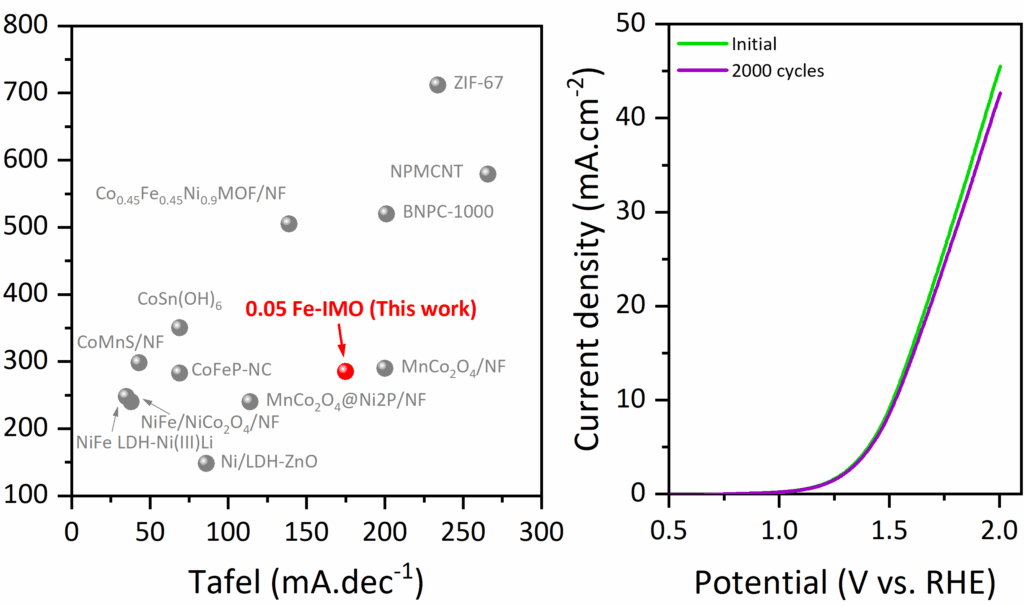
Figure 3. (left) OER performance comparison between Fe-doped Ge-INT at x = 0.05 and other reported materials at overpotential j = 10 mA.cm−2. (right) Polarization curve before and after durability test for Fe-doped Ge-INT at x = 0.05.
These results, published in Advanced Functional Materials, show that it is possible to produce effective and stable catalysts without using noble metals, paving the way for new, more sustainable technologies in the context of the energy transition.
Reference
GeAl2-2xFe2xO3(OH)4 nanotubes: new electrocatalyst for oxygen evolution reaction.
Y. Naciri, J. Li, W. Ullah, F. Baron, F. Bourdelle, S. Rouzière, C. Goldmann, E. Elkaim, T. Bizien, R. Belkhou, D. Vantelon, M. N. Ghazzal, E. Paineau
Advanced Functional Materials, 2026, 36, e15690
doi: 10.1002/adfm.202515690
News on CNRS Chimie website (in French) and synchrotron SOLEIL website.
Also featured in the SOLEIL Synchrotron’s 2025 Highlights Collection.
Contact
Erwan Paineau