
Researchers from the Laboratoire de Physique des Solides (LPS), in collaboration with several partners, have revealed that ion transport in ionic liquids is governed by a heterogeneous nanostructured organization, providing new insight into these promising electrolytes for next-generation batteries.
Ionic liquids, which are fluids composed entirely of ions, exhibit remarkable properties, including negligible volatility, high thermal stability, and a wide electrochemical window. These characteristics make them attractive candidates as electrolytes for lithium and post-lithium batteries. However, their performance depends directly on ion transport, a phenomenon that remains poorly understood because of the complexity of their internal organization.
By combining X-ray scattering, nuclear magnetic resonance (NMR), and molecular simulations (Figure), the LPS researcher and collaborators demonstrated that these liquids are far from homogeneous. Instead, they display a nanostructured organization with strong local heterogeneities. At this scale, ion-rich domains coexist with more mobile regions, forming a dynamic mosaic whose properties vary significantly across space and time scales.
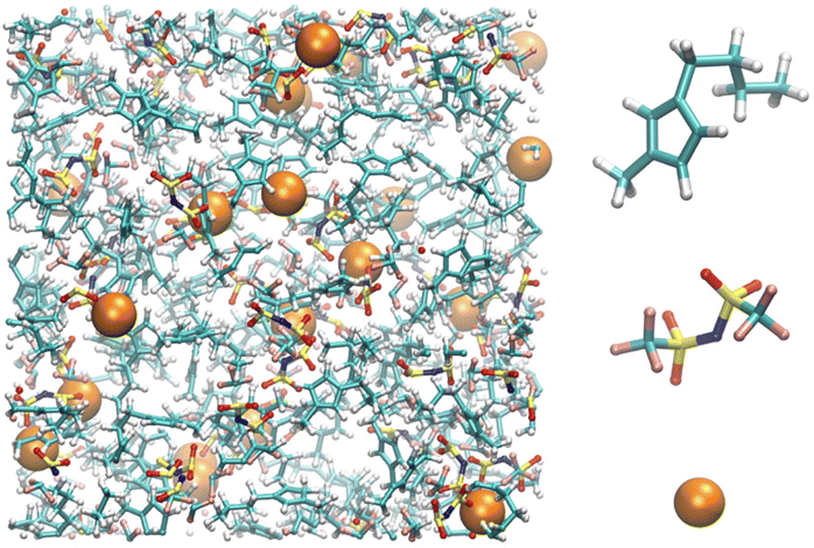
Figure. A typical molecular configuration used to study the properties of ionic liquid-based electrolytes using molecular dynamics. This sample contains 104 BMIm⁺ cations, 20 Li⁺ ions, and 124 TFSI⁻ anions, corresponding to the composition [BMIm][Li][TFSI]₀.₂. The box is at T = 300 K and has dimensions of L ∼ 38 Å in all directions. Each type of ion is shown on the right: BMIm (top), TFSI⁻ (middle), and Li⁺ (bottom). The atoms are colored as follows: carbon (cyan), hydrogen (white), fluorine (pink), sulfur (yellow), oxygen (red), nitrogen (blue), and Li⁺ (orange).
Ions trapped in local environments: The study reveals that ion mobility strongly depends on the immediate local environment. Some ions are tightly bound within coordination structures or aggregates, which slows down their diffusion, while others move much more freely. This coexistence of different dynamical behaviors explains the broad distribution of diffusion rates observed experimentally and reproduced through molecular dynamics simulations.
A new picture of ion transport: Using an original approach that tracks individual ions, the researchers established a direct link between local structure and dynamics over timescales ranging from picoseconds to hundreds of nanoseconds. These findings challenge conventional average-based descriptions and demonstrate that ion transport in such systems is intrinsically heterogeneous and multiscale. They also explain how changes in electrolyte composition affect transport properties. This detailed understanding opens new avenues for designing electrolytes better suited to next-generation batteries by controlling nanoscale structuring and ionic interactions in order to optimize ion transport.
Contributors
Laboratoire de Physique des Solides (LPS), partner
Laboratoire Léon Brillouin (LLB)
Laboratoire Interdisciplinaire de Physique (LiPhy)
Laboratoire d’Électrochimie et de Physicochimie des Matériaux et des Interfaces (LEPMI)
Institut Laue-Langevin (ILL)
Funding
CNRS
CEA
Centre Informatique National de l’Enseignement Supérieur (CINES) (Project A0040807695)
GRICAD, Rhône-Alpes Region (Grant CPER07-13 CIRA)
Equip@Meso Project (ANR-10-EQPX-29-01)
Reference
Patrick Judeinstein, Hoang Phuong Khanh Ngo, Fabrice Cousin, Cristina Iojoiu, Emilie Planes, Benoît Coasne
Structural and Dynamical Heterogeneities at the Nanoscale in Alkali/Alkaline-Earth Ionic Liquid Electrolytes: Experiment and Molecular Simulation
Physical Chemistry Chemical Physics, 2026, 28, 3850–3865. DOI: 10.1103/3pmg-b78n
2026 HOT PCCP article
Contact
Patrick Judeinstein – patrick.judeinstein@cnrs.fr